



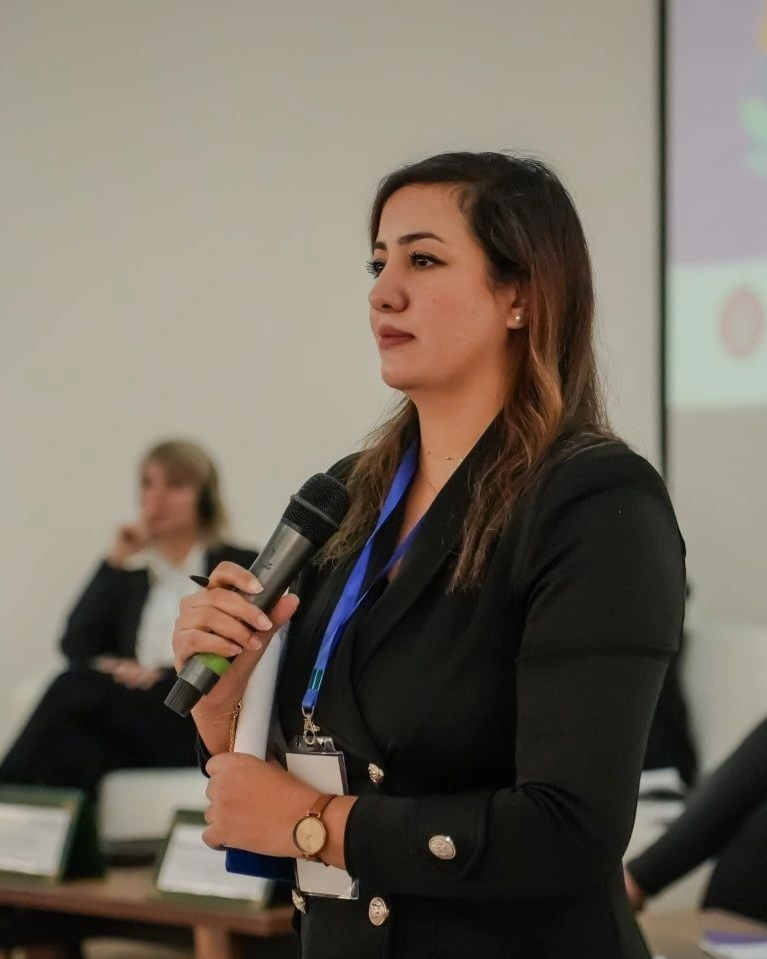
For more than ten years, Mouna Saihi has been working to make citizen participation a lever for transforming public action, well before Moroccan institutions took up the issue. A multifaceted profile, Mouna supports public institutions and international donors in their participatory approaches. Today, she has turned her attention to civic tech, which she sees as the next opportunity to advance digital dialogue with citizens, still uncommon in Morocco. A portrait of a Missions Publiques Fellow.
In the early 2000s, Mouna Saihi moved to France to pursue her studies, where she developed an early interest in public policy and its institutional architecture. She then decided to devote her doctoral thesis to participatory practices in Morocco, her home country, at a time when the subject remained largely absent from Moroccan public policy. As she explains, participatory practices and initiatives already existed throughout the 2000s and early 2010s, but they were driven primarily by civil society rather than by public institutions. It was a challenging research topic for a young scholar, but that very challenge is what motivated her, leading her to explore the relationship between public decision-makers and citizens—a question that has become the common thread running through her career.
What also drives Mouna in her work is the question of whether public policy can understand and respond to the realities of a territory and its residents. In 2010, she supports several Moroccan municipalities as they draft, for the first time, their communal development plan, a strategic document setting out the territory’s priorities for the years ahead. For nearly eight months, she works alongside elected officials, civil servants, and residents to carry out this unprecedented exercise. It is on this occasion that she discovers the role of strategic territorial planning, a specialty that draws her even closer to participatory democracy. The experience reinforces her conviction: decisions cannot be made in place of citizens — they must be consulted, and the territory must be built alongside them.
From research to action: the birth of PublicPart
After several years of study, research, and an initial professional experience at a specialized firm in France, she chooses to return to Morocco. Back home in 2015, she joins a pilot participatory budgeting project, an approach already well established in France but still untested in the Moroccan context. It was the first time the European Union had partnered with municipalities in the north of the country on this issue. For eight months, the pilot unfolds across three cities — Chefchaouen, Tétouan, and Larache — bringing Mouna closer to neighborhood associations. She discovers in herself a new drive: to document and showcase these grassroots initiatives, convinced that officials, elected representatives, and citizens alike need clear reference points to develop this kind of approach.
It is this experience that gives rise to her desire to strike out on her own and create a space capable of supporting these actors. She first envisions a collective, inspired by French organizations such as Démocratie Ouverte. But in 2015, the subject is still too new in Morocco to find an audience. She redirects her project toward a consulting firm instead, a format better suited to the needs she observes on the ground: technical assistance, support, capacity building. This is how PublicPart is born.
Among the projects carried out by PublicPart, three stand out in particular:
- In Salé, Rabat’s twin city, Mouna Saihi is commissioned by GIZ (the German international cooperation agency) to study the creation of a citywide consultation mechanism. Her field assessment leads to the creation of the “Thursday Consultation,” a citizen assembly bringing together elected officials and residents around specific topics — an initiative that draws attention from the OECD, among others.
- More recently, through the EqualMED program, she supports Moroccan municipalities in integrating equality policies, drawing in particular on experiences from Barcelona.
- The project that remains most meaningful to her, however, is the creation of Morocco’s first remote listening platform for women who are victims of violence, developed together with the relevant public authorities. Launched at the dawn of the COVID lockdown, it met a particularly urgent need for listening and support, at a time when victims found themselves more isolated than ever.
A desire for participation waiting to be expressed
Mouna describes herself as a hybrid profile, shaped by experiences on both sides — in France and in Morocco, as an academic and as a field researcher. She tells us this is what allowed her to develop a distinctive perspective on citizen participation in Morocco.
Indeed, mechanisms she was able to observe closely in France, such as neighborhood councils or citizen juries, have no real equivalent yet in the Moroccan landscape. Comparable bodies do exist on paper, however: youth councils and municipal committees on equal opportunity and gender. The issue is not that these bodies don’t exist, but that they often remain inactive, sometimes little more than institutional shells. Reactivating them — diagnosing what isn’t working in order to get them moving again — is now an integral part of her work.
For Mouna Saihi, this lack of mechanisms is in no way a sign that citizens are uninterested. “Moroccan citizens, in my experience, are thirsty for participation,” she says. Whenever a citizen mobilization is organized — a debate or a consultation around a municipal action plan, for example — people show up, with quality proposals that are then passed on to municipal presidents. For her, the real gap lies in the availability of spaces for dialogue, not in citizen engagement itself. As a law on public consultation is currently being drafted in Morocco, she is careful to point out that it will have “nothing to do with the regulatory consultation process as it is understood in France.”
Civic Tech, the new turning point
One comparison that has struck Mouna the most is this: where France has a multitude of digital consultation platforms, Morocco has only one platform dedicated to citizen participation at the national level, e-participation.ma. At the local level, no platform yet allows municipalities to open this kind of direct dialogue with their residents.
Rather than waiting for this field to take shape, Mouna Saihi has turned her attention to civic tech, which she sees as a major driver of public sector transformation and socio-political change. Convinced of their potential to reshape the relationship between citizens and public institutions, she believes these digital tools can open up new forms of participation and strengthen democratic governance. As she put it during our interview: “I believe that, starting in 2026, we are truly entering the era of civic tech.” For Mouna, civic tech has the potential to expand digital citizen participation in Morocco, rebuild trust between citizens and institutions, and, more broadly, help design cities not only for citizens, but with them.
Mouna is well aware of the challenges this digital shift raises, particularly around inclusion. While she acknowledges the limits of these tools, she sees them above all as an opportunity to bring citizens who are most distant from public life closer to it, to strengthen transparency, and to help fight corruption.
Mouna Saihi is a Missions Publiques Fellow. https://missionspubliques.org/the-global-fellows-program/


