



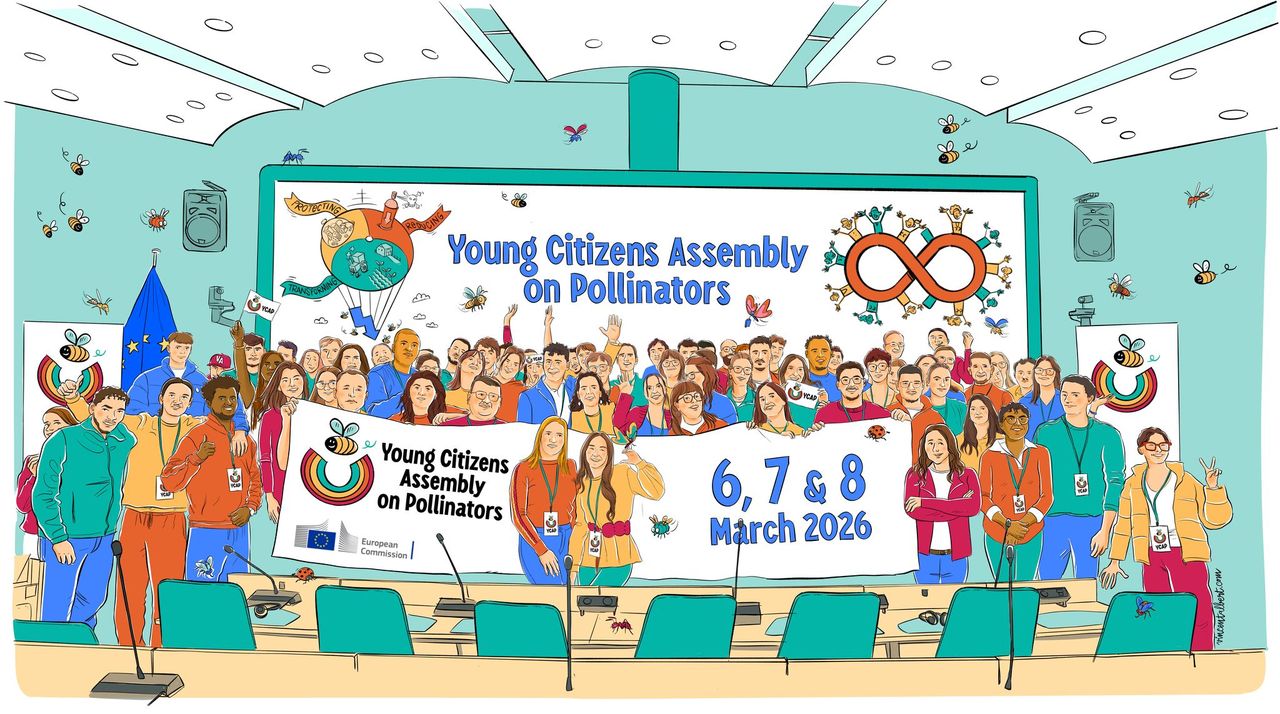
The very first Youth Citizens’ Assembly on Pollinators is coming to an end… or perhaps this is only the beginning. Over the course of three weekends in Brussels, 100 young people aged 18 to 29 from across Europe came together to address two questions: how can we reverse the decline of pollinators, and what role can young people play in biodiversity governance in Europe? On 8 March, they presented their final opinion to the European Commission. Of the 34 actions submitted to a vote, 32 were adopted.
Jointly initiated by the European Commission’s Directorate-General for Environment and the Joint Research Centre, this Assembly is a first. Never before had such a participatory process been put in place to involve young people so closely in every stage of a political reflection on biodiversity.
From the outset, participants approached pollinator decline not as an isolated environmental issue, but as a systemic challenge. For them, the issue is tied to the way societies produce food, use land, direct funding and organise collective decision-making. From this analysis, they developed a series of ambitious proposals structured around several major areas.
Phasing out pesticides, without placing the burden of transition on farmers alone
The Assembly sets a clear course: reduce pesticide use by 50% by 2030, then move towards near-total elimination by 2040. This is an ambitious objective, but one the young participants refuse to turn into a punitive injunction. “It is too easy to look for one single culprit, the whole system is involved,” as one participant put it. The transition, they argue, must therefore be gradual, structured and supported.
To achieve this, they first call for stronger pesticide risk assessments so that they become more rigorous, more independent, and funded by the European Union rather than by industry. They also want to put an end to what they see as a major inconsistency: imported products should meet the same standards as those produced within the EU. Otherwise, European farmers who reduce their use of pesticides risk facing unfair competition.
Participants also call for CAP subsidies to be redirected in order to support those who commit to this transition. In urban spaces (gardens, parks and public areas) they advocate a complete ban on pesticides, with monitoring and enforcement carried out at local level.
Another central lever is the development of ecological alternatives. The young citizens call for better promotion of solutions that already exist, as well as stronger independent research on biological and mechanical pest control methods. To finance this effort over time, they propose the creation of a permanent fund financed through a tax on pesticide producers. This fund would support both research and public information campaigns. Behind all these proposals lies the same ambition: reconciling agriculture with the protection of living ecosystems.
Transforming the agricultural model by supporting those who sustain it
Beyond pesticides, participants believe that the agricultural model as a whole must evolve. Their objective is clear: over the next twenty years, European agriculture should become more sustainable, more diversified and more compatible with the preservation of pollinators. But this transformation, they insist, can only succeed if farmers are supported rather than singled out as the only ones responsible.
This first requires making the profession more attractive and more accessible, especially for young people, by making it easier to set up a farm or take over an existing one. Training programmes should fully integrate ecological issues, so that farmers are better equipped to understand and adopt alternatives to pesticides. Participants go even further: in their view, access to certain European funds should be conditional on commitment to training and to the transition.
They also call for a reform of the CAP so that it provides greater support to small, diversified farms while strengthening environmental requirements for large intensive monocultures. This should be accompanied by financial aid and tax relief designed to encourage sustainable practices, taking into account the size and type of farm. To reduce conflicts of interest in the allocation of these funds, they propose that an independent body from civil society should play an oversight role.
The young citizens also argue for better protection of local and organic products against international competition, as well as stronger support for regenerative agriculture. They want these products to become more accessible to consumers, for example through the removal of VAT on organic products and better visibility in supermarkets. Finally, they call for private banks to dedicate a minimum share of their agricultural lending to ecological practices. “Money shows what really matters,” one participant said. As long as financial flows do not more strongly support the transition, it will remain incomplete.
Rethinking land use to recreate habitats that are favourable to pollinators
For participants, protecting pollinators is not only about farmland. It concerns all territories, whether urban, rural, agricultural or abandoned. Their goal is to make these spaces progressively more pollinator-friendly, with clear milestones: 15% of land concerned by 2030, then 20% by 2035.
But first, it is necessary to define what a “pollinator-friendly” space actually is. The young citizens therefore propose the development of indicators co-designed by national, European and academic experts. These indicators would feed into a European land-mapping platform, funded by the EU and accessible both to public decision-makers and landowners. The aim is to identify priority areas for restoration and better guide land-use planning policies.
But mapping alone is not enough. Participants also want the real effects of public policies to be measured. They call for systematic monitoring of pollinator populations, together with financial incentives for farmers whose ecological results are measurable and verified.
In the same spirit, they call for the EU Transparency Register to be strengthened, with more precise information on the sums involved, the issues discussed and the stakeholders consulted, including in the Parliament and the Council. They also want clear sanctions in cases of corruption. An annual report on the state of pollinators would complete this framework, helping to establish a shared overview across institutions, territories and citizens.
On the ground, the young citizens call for public spaces and buildings to be greened so that they become real habitats rather than simply decorative green areas. They also want ecological corridors funded by the EU, allowing pollinators to move between habitats that are currently too fragmented. Finally, they stress that rural areas must not be overlooked: improving living conditions outside large cities would also help reduce pressure on land that has not yet been heavily artificialised.
Raising awareness from an early age to make the transition possible
In their view, none of these measures can produce lasting results without a profound cultural shift. “You cannot change what you do not understand,” one participant pointed out. Awareness-raising is not, on its own, a sufficient response. But it is a necessary condition for success.
The young citizens stress the need to reach a wide audience, including people who do not feel concerned by the issue. They advocate long-term awareness-raising, connected to concrete policy measures, and embedded from early childhood throughout education. This could take the form of direct experiences, farm visits, field trips, educational projects, but also an annual “Green Week” in schools. The objective is clear: to embed the question of living systems more deeply in collective representations, habits and choices.
Giving youth a lasting place in European biodiversity governance
This Assembly did not only work on pollinators. It also put forward a political vision of the role young people want to play in European biodiversity governance.
Participants start from a simple observation: today’s young generations, and those that follow, are the ones who will live longest with the consequences of biodiversity loss. “We will still be here in 60 years and will have to live with the consequences,” one of them said. Yet many of them still feel underrepresented in political systems they perceive as slow, complex and dominated by older generations.
They therefore propose the creation of a permanent youth citizens’ assembly, equipped with a genuine independent consultative mandate. This body could define priorities, issue official recommendations and request a moratorium on legislative proposals considered harmful. Its composition would be mixed: 40% randomly selected citizens, 40% people with relevant experience, and 20% former members to ensure continuity. Its functioning would be hybrid, with four in-person sessions each year.
At the end of each assembly, 27 elected representatives, one per Member State, would ensure the link with national and European institutions. Participants also call for the European Parliament to respond in writing to their recommendations within four months.
To ensure that this voice does not remain confined to Brussels, they also envision a multichannel communication strategy using social media, the press, television and public transport networks.
Task forces to keep the Assembly alive beyond the sessions
One of the original features of this Assembly also lies in the “task forces” set up throughout the process. Divided into four groups, communication, artistic expression, monitoring and advocacy, the young participants did not only deliberate: they also contributed very concretely to bringing the Assembly to life.
The communication task force created its own social media accounts, produced content on the Assembly’s activities, and wrote articles and newsletters. The artistic expression task force organised an exhibition within the European Commission itself, bringing together paintings, poems and handmade creations. The monitoring group evaluated each session through questionnaires and formulated recommendations to improve the following ones. As for the advocacy task force, it met local authorities, addressed European Commissioners and engaged with high-level decision-makers, including European Parliament Vice-President Martin Hojsík.
By inviting young people to take part not only in the discussions, but also in the design and visibility of the process, these task forces extended the experience far beyond the formal deliberative moments. In practice, they sketch out what the internal governance of a permanent assembly could look like. This involvement, like their participation in the Assembly, will be recognised through a digital badge.
An ending… or the beginning of a different way of making decisions
This first Youth Citizens’ Assembly on Pollinators is therefore not simply the conclusion of a participatory exercise. It opens up a broader path: that of a European democracy capable of seeing young people not as a public to be consulted from time to time, but as a lasting actor in the transitions ahead.


