



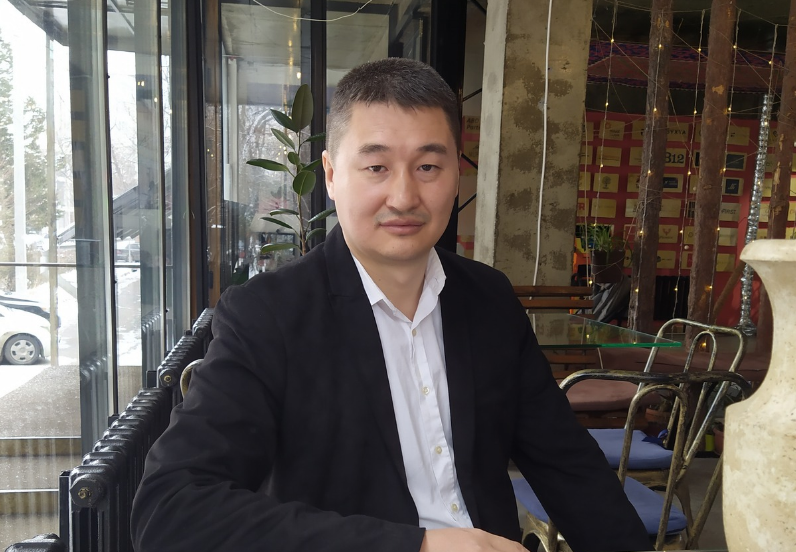
For more than 15 years, Ulugbek Nurumbetov has worked for peace in Kyrgyzstan, his home country, as close as possible to local communities. In 2019, he founded the Institute for Peace and Development (IPD), which he has led ever since, and developed its network of Peace Clubs, now one of the country’s largest community-based peacebuilding networks. A portrait of a Missions Publiques Fellow.
Before founding the IPD, Ulugbek spent several years working for international organisations active in Central Asia. After an internship at a German organisation partnering with ifa (the German Institute for International Cultural and Educational Relations), he worked for five years on several projects in Kyrgyzstan: peace dialogues, a training programme for peace and conflict consultants, and a project to prevent religious radicalisation among young people.
For years, he took part in coordination meetings of around ten NGO consortia funded by the Kyrgyz state and donors such as the European Union. There, he observed a reality shared by all these organisations: concentrated in the capital and provincial centres, they kept reaching the same participants and never a wider population. This observation drove him to do things differently, this time by building organisations rooted directly at the community level. This is how the Institute for Peace and Development came into being in 2019.
The success of the Peace Clubs
“The IPD’s mission is to promote peace and social cohesion by supporting peace initiatives, providing civic education and fostering the development of community organisations,” Ulugbek explains. Of all the institute’s projects, the Peace Club network is the one he is proudest of.
The first clubs were set up in late 2020, in the middle of the pandemic. In his previous projects, Ulugbek had noticed that once they ended, participants rarely kept up their involvement on their own. He therefore decided to invest in collective structures rather than individuals, with clubs of at least 20 members each, so that they never depend on just one or two people.
A Peace Club brings together mainly young people, but also teachers and community leaders, around a shared committee. Free and open to all, the clubs are based in schools. This choice reflects a local reality: in rural Kyrgyzstan, Ulugbek explains, the school is often, along with the mosque, the only real community space in the village. There is usually no theatre, library or cinema. So it is at the school that events, celebrations, elections and even concerts take place.
The clubs rely on toolkits and training modules designed by the IPD, passed on from one generation of students to the next so that the work can continue over time. The network tackles very real social issues, starting with human trafficking. With more than half of the working-age population having emigrated, mainly to Russia and Kazakhstan, the country is among the world’s main sources of trafficking. The network also works to counter religious radicalisation and, more recently, gender-based violence.
The network grew quickly: 10 schools in the first year, more than 50 in the second, more than 80 in the third. It keeps growing every year, often without direct involvement from the IPD. In a remote district where the institute had never worked before, teachers set up 15 clubs on their own initiative. Today, more than 300 clubs are active across the country, bringing together several thousand young leaders and 600 teachers. According to Ulugbek, the director of a national civic education programme told him that the IPD’s network had the greatest civic reach in this field, more than all the United Nations agencies combined.
Long nicknamed Central Asia’s “island of democracy”, Kyrgyzstan still stands out from its neighbours for its more pluralistic political history. But Ulugbek observes that civic space is shrinking. Power is increasingly concentrated around the president and a small elite, organised opposition has disappeared, independent media are becoming scarce, and 400 to 500 NGOs have reportedly closed or relocated to Kazakhstan. In his view, the country is drawing closer to its neighbours’ political model.
He attributes part of the distrust towards NGOs to the country’s recent history. Several uprisings have toppled governments in the name of democracy, without the situation really improving. NGOs, often associated with the political leaders brought to power by these movements, paid the price: the very leaders who relied on them to gain power turned against them once elected, branding them “foreign agents“.
Inspired by Russian legislation, a bill to this effect was debated in Parliament for several years. It required any organisation receiving foreign funding to register as such and submit to tighter controls. First rejected in 2016 after heated debates, and proposed unsuccessfully by previous presidents, it was finally adopted under the current administration. According to Ulugbek, the law was then backed by more than 95% of the population, a figure that, in his eyes, above all reflects the lack of trust in NGOs. “This process revealed how low NGOs’ credibility was,” he explains. “People simply don’t understand what they do; they associate them with foreign interests rather than local needs.”
 Building a movement from the ground up
Faced with this situation, Ulugbek sees only two options: work with the government or build support directly from the population. The IPD chose the second path. United Nations agencies now support its work more actively: UNICEF is currently funding the creation of new clubs in new communities. Ulugbek’s goal is eventually to cover at least half of the country’s schools.
“We are building a real movement. The more ordinary citizens are part of it, the less they see us as an outside actor, and the more they see themselves as stakeholders.”
Ulugbek Nurumbetov is a Missions Publiques Fellow: https://missionspubliques.org/the-global-fellows-program/


