



What remains of a European citizens’ panel two years after it concludes? In the case of the European Citizens’ Panel on Energy Efficiency, the answer is clear: tangible traces in European policies. Brought together again on 6 February 2026, participants saw how their 13 recommendations had been taken up by the European Commission and translated into action. A rare and valuable moment of feedback.
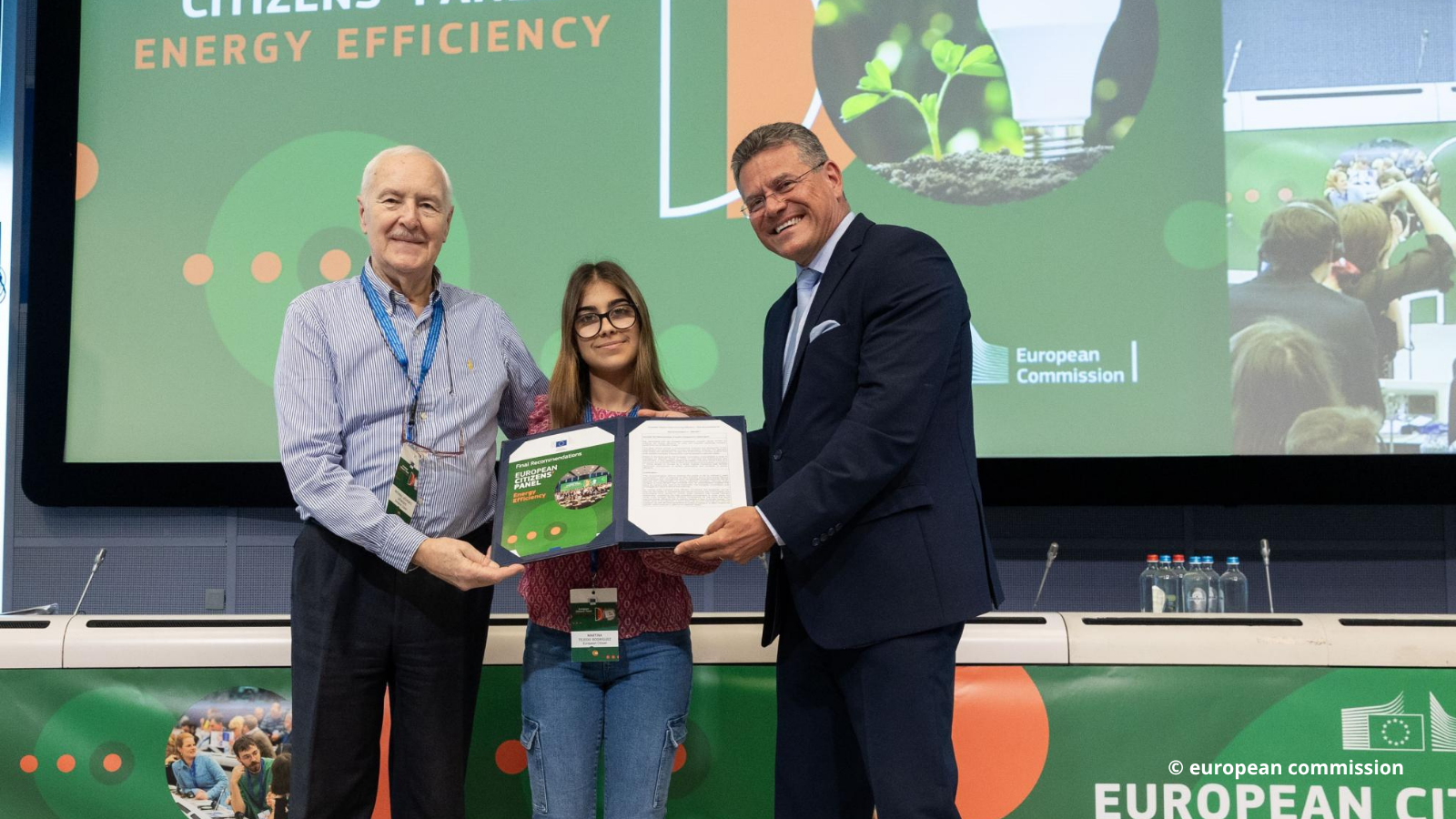
In 2024, 150 citizens randomly selected from across the 27 Member States of the European Union worked over three weekends on a single question: how can energy efficiency become a concrete lever for citizens, public authorities and businesses? Their discussions led to 13 recommendations, which were presented to Maroš Šefčovič, then Executive Vice-President of the Commission in charge of the European Green Deal. Diverse as they were, these proposals shared a common goal: to prioritise reducing energy demand over increasing supply. Two years later, the Commission came back to them to show what had been set in motion. Each recommendation received a response, and each found its way into European policies. For participants, this follow-up gives the experience a particular significance. It is no longer simply a matter of having been consulted, but of having helped, in their own way, to shape public decisions.
When Everyday Realities Enter the Making of European Policies
“These recommendations were inspired by your daily lives, your everyday realities. They brought a citizens’ perspective to the making of EU policies,” recalled Sophia Eriksson Waterschoot, Deputy Director-General of the European Commission’s Directorate-General for Communication. Rosalinde van der Vlies, Director for Just Transition, Consumers, Energy Efficiency and Innovation at DG Energy, made a similar point: the recommendations formulated two years ago appear even more relevant today, at a time when rising energy prices, difficulties in heating or cooling homes, and extreme temperatures are making the need for action ever more urgent.
To present this follow-up, the Commission grouped progress around three broad areas: modernising the energy system, social justice and the right to renovation, and action at local level. At heart, these are three ways of responding to the same expectation expressed by citizens: making the energy transition a policy that is more effective, fairer and closer to everyday life.
Modernising the Energy System to Reduce Vulnerability
The first area focuses on modernising Europe’s energy system. Launched in the context of the energy crisis, it addresses very concrete questions raised by citizens: where the energy consumed in Europe comes from, how it is transported, which sources should be prioritised, and how energy use can be better measured. The REPowerEU plan, developed after the invasion of Ukraine, aims to diversify supplies while strengthening energy savings. The Commission is also working on a strategy for heating and cooling, while nearly half of all energy consumed in Europe is used for these purposes and a significant share is still lost as heat. Recovering this energy more effectively would both reduce primary energy consumption and limit dependence on imported gas.
The digital sector is also part of the picture. With the rapid growth of data centres, the question of their sustainability is becoming increasingly important. Mandatory reporting and a European label are being prepared, with the possibility of linking them to minimum performance standards in order to spread better practices across the sector. Another major initiative is the European Grids Package, presented in December 2025, which is intended to modernise Europe’s electricity grids so they can better integrate renewable energy, secure supply, and reduce the cost of outages.
Making the Transition a Project Accessible to Everyone
The second area concerns social justice, a central issue in the citizens’ recommendations. The challenge is simple: to ensure that everyone, not only those who can afford it, can benefit from energy savings. The Commission highlights several responses in this respect, including the European Energy Efficiency Financing Coalition, which is intended to make access to credit easier for households, SMEs, and above all the most vulnerable groups.
At the same time, housing is becoming a major lever: the European affordable housing plan adopted in 2025, enhanced certificates and personalised renovation passports in the revised Energy Performance of Buildings Directive, and support for the training of professionals through BuildUp Skills. Behind these measures lies a shared idea: without support, accessible funding and a skilled workforce, renovation remains out of reach for many.
The Social Climate Fund: A Strong Signal
This is also the context in which the Social Climate Fund fits, one of the most significant developments presented during this follow-up. Launched in 2026 and planned to run until 2032, it will mobilise up to €86.7 billion to help vulnerable households and micro-enterprises renovate their homes, adopt cleaner heating systems and access affordable transport solutions. Each Member State will have to prepare a national social climate plan through mandatory consultation with citizens.
For Carlos Sanchez Rivero of DG Energy, this consultation made it possible to be “more precise, more concrete and more targeted”. One participant even felt that the scheme went “beyond” what citizens themselves had recommended.
Making the Transition More Tangible, Simpler and Easier to Understand
The third area, finally, is about bringing the energy transition closer to everyday life. The panel’s recommendations were not only about broad strategic directions; they also expressed a need for simplicity, clarity and practical support. This is the spirit behind the future Citizens Energy Package, which aims to put consumers back at the centre of the energy system. In particular, it seeks to make the market easier to understand through comparison tools for offers, and to better protect citizens against abusive commercial practices.
Ultimately, this reflects an important shift: no longer leaving individuals alone to deal with the complexity of the energy market, but giving everyone the means to make informed choices.
Concrete Tools for Action at Local Level
This approach also relies on very practical tools. One-stop shops, now mandatory in all Member States, are meant to provide citizens with a single point of entry for information on renovation, technical solutions and available funding. Fifty-one such structures have already been supported in 18 Member States.
The Commission also mentions implementation dialogues, regular consultations with stakeholders, and, since 2026, an Energy Behaviour Forum designed to help local authorities encourage more energy-efficient practices through behavioural science.
What Participation Changes for Those Who Take Part
Beyond the policies themselves, this follow-up shows what participation has produced for those who took part in it. Around 80% of participants say the experience mattered to them. Some changed their own practices; others became advocates for citizen participation within their own circles.
Their testimonies clearly show this shift. One explains that, despite already leading a relatively energy-conscious lifestyle, the panel made him aware of structural barriers he had not fully grasped before.
Another says the experience was a turning point, leading him to launch two concrete projects in his neighbourhood in Berlin. A third emphasises a simpler but decisive point: being able to speak and being heard changed the way he approaches life in general. Three different paths, but one shared conclusion: participation does not simply turn an opinion into a recommendation; it can also transform one’s relationship to action.
When Follow-up Gives Credibility to Participation
This is no doubt where this feedback exercise finds its full value. Not only because it highlights the concrete follow-up given to citizens’ recommendations, but also because it shows what transparent follow-up produces: it strengthens the credibility of participation itself.
-
For more information
-
Read the final report of the Energy Efficiency Panel here
- To find out more about our involvement


