



How can experiences from other parts of the world challenge European research on democratic innovation? As part of the ScaleDem project, the Reversing the Gaze workshops invited researchers and practitioners from several regions to discuss the team’s initial analysis. Max Povse, researcher at the European University Institute, and Vladislava Gubalova, researcher at GLOBSEC, explain the approach.
Missions Publiques. Why did you want to “reverse the gaze”?
Max Povse. When mapping democratic innovations in Europe, we noticed that several shared characteristics shaped by the European Union’s context: transnational partnerships, better access to funding and a network of specialist organisations. Our analytical framework was also rooted in that setting.
Those of us who had worked in other parts of the world felt that we were missing important lessons, or talking in an echo chamber. Democracy research is often criticised for being Eurocentric. We wanted to take that criticism seriously, so we included the Reversing the Gaze workshops in the project from the outset.
We wanted partners working in other contexts to examine our European findings and question our assumptions through their own experiences.
"If we want to develop a theory of scaling that is useful in different settings, it needs to draw on experiences beyond our own region. Learning has to work both ways.
Vladislava Gubalova
researcher at GLOBSEC
Missions Publiques. What did you ask participants to discuss?
Max Povse. We asked whether what we had observed in Europe also existed elsewhere, whether our findings resonated with their practice, and what their experiences could contribute to our analysis. The aim was to go beyond sharing preliminary findings and genuinely put them to the test.
Vladislava Gubalova. The workshops brought together participants from Latin America, Asia, Africa, Eastern Europe and the Western Balkans. Discussions explored what people understand by “democratic innovation” and “scaling”, as well as the factors that can support that process.
These concepts are understood differently across contexts. If we want to develop a theory of scaling that is useful in different settings, it needs to draw on experiences beyond our own region. Learning has to work both ways.
Missions Publiques. Can you give an example of an assumption these discussions challenged?
Max Povse. In our exchanges with Latin American partners, we were surprised to find that digital innovations ranked at the bottom of their priorities and were sometimes seen as undesirable. This contrasted with the emphasis on digital tools and artificial intelligence in the European agenda and in several of the cases we had studied.
Their argument was that reducing person-to-person interaction could erode trust and solidarity, undermining the very purpose of democratic innovation.
The workshops challenged some of our findings and many of our assumptions, more than the feedback we had received from our European partners up to that point. The variety of responses led us to give context a much more central place in our analysis.
“The workshops challenged some of our findings and many of our assumptions.” – Max Povse
"Ultimately, this work will inform a “Compass” for policymakers and practitioners seeking to develop and scale these initiatives.
Max Povse
Researcher at the European University Institute
Missions Publiques. How will this work inform the next stages of the research?
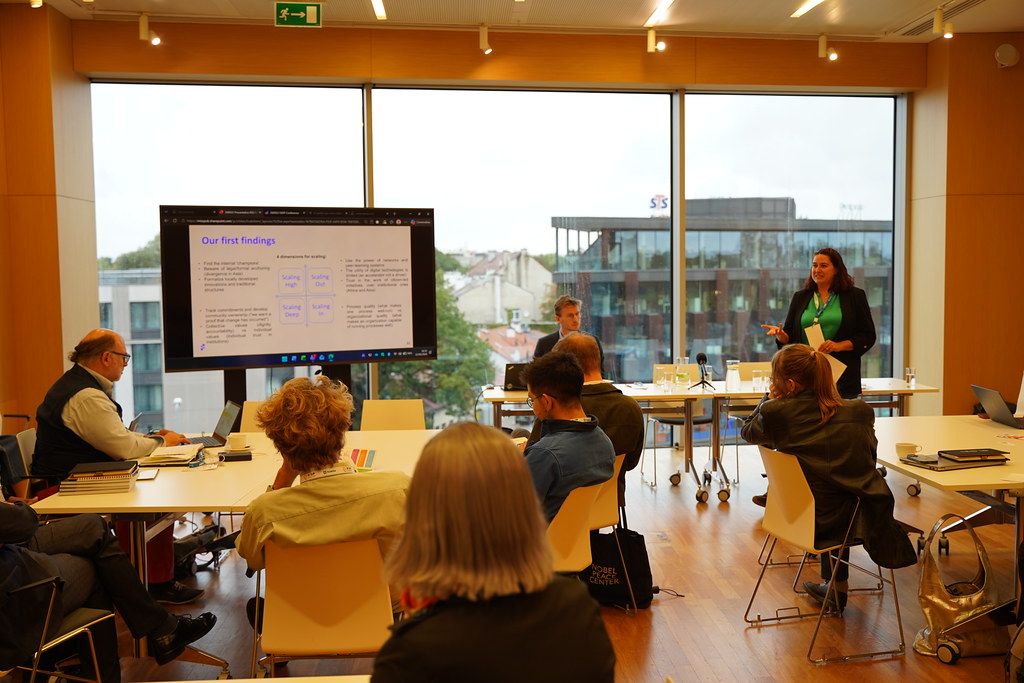
Vladislava Gubalova. We also presented these initial lessons at a workshop during the International Observatory on Participatory Democracy conference in Kraków, co-hosted with Léo Police, researcher-consultant at Missions Publiques. The feedback supported some observations and added new nuances to our thinking.
Max Povse. The Reversing the Gaze report, due to be published in late November, will bring together the lessons from the four workshops and the feedback from Kraków. It will contribute to our work on the conditions under which democratic innovations can scale.
Democratic innovation projects will also put lessons from European and non-European contexts into practice. Ultimately, this work will inform a “Compass” for policymakers and practitioners seeking to develop and scale these initiatives.
Find out more
- Initial lessons from Reversing the Gaze presented in Kraków
- Missions Publiques’ involvement in ScaleDem


