



Among the participatory initiatives multiplying in the run-up to the presidential election, the DemoCIS research project proposes to put democracy itself up for discussion. On 12 and 13 September, its Citizens’ Convention brought together randomly selected citizens, members of parliament, civil society representatives and researchers in Lille (North of France) to lay the foundations for tomorrow’s democracy. Its distinctive feature is to turn this participatory experience into a genuine field of research, observed by researchers from several disciplines. One question will guide the work until December: what kind of democracy do we want?
The Convention is the first major participatory initiative of the DemoCIS research programme, led by the University of Lille and funded under France 2030. Meeting over four weekends from September to December, it brings together 52 randomly selected citizens, parliamentarians and civil society representatives, ahead of the formulation of recommendations in early 2027. Missions Publiques is responsible for its methodological design and facilitation.
But the approach goes beyond participation: the discussions also serve as research material. DemoCIS involves more than 330 researchers from a wide range of disciplines – including sociology, political science, law, philosophy and linguistics – working in particular on the crisis of institutions, changing forms of citizenship, polarisation and information disorder. The Convention’s work is therefore observed and studied throughout the process.
Régis Bordet, President of the University of Lille, stressed this dimension to the participants: “In terms of methodology, it cannot be challenged from a scientific point of view. It may be challenged politically, and that is to be expected, but not scientifically. Today we need scientists, not just bar-room science. Your work will be a landmark and will feed into the elections ahead of us, both in France and in other European countries.”
On arrival, each participant chose two images. One to represent what inspires them about democracy today. The other to express what worries them.
It was with this gesture that the first session of the Citizens’ Convention for Democracy opened on Saturday 12 September at the Atelier of Sciences Po Lille. It was a way of approaching the subject not through institutions, articles of the Constitution or reforms to be imagined, but through the experiences, memories and perceptions of those who would spend the next two days discussing it.
What Still Holds. What Works Less Well. What Causes Outrage.
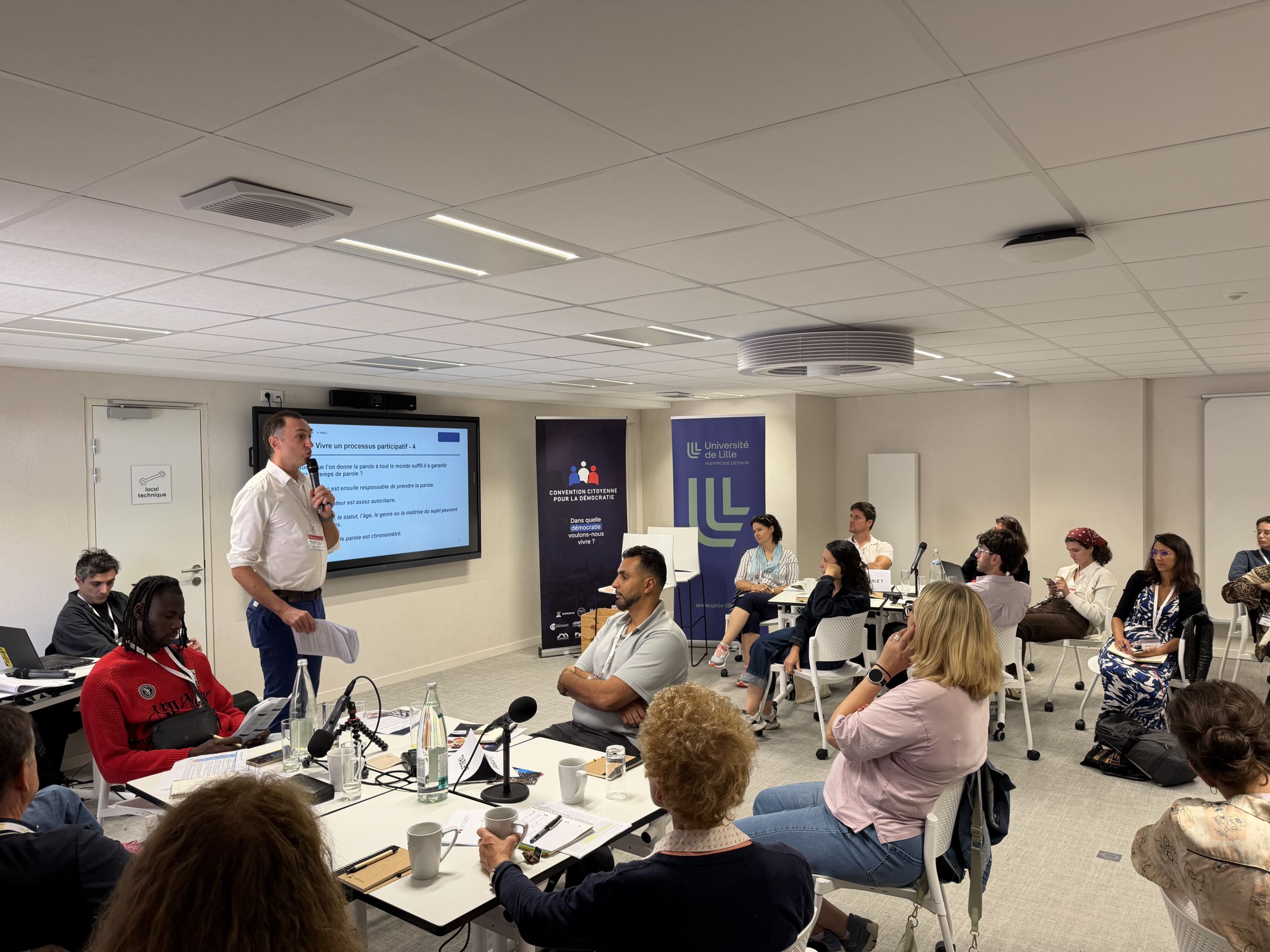
With this framework in place, members got to the heart of the matter: what works in our democracy today? What works less well? And what causes outrage?
The discussions revealed both strong attachments and dissatisfaction. Participants mentioned in particular democratic freedoms, voting and local democracy, while raising questions about representation, participation between elections and the functioning of institutions.
These initial findings are not yet conclusions. They are a starting point for the work ahead: identifying what deserves to be preserved, what needs to be questioned and which topics the Convention will need to explore further in the coming sessions.

From Assessment to the Democracy We Want
Members were invited to imagine the democracy they would like to see tomorrow. The discussions raised several major questions: how can everyone be enabled to take greater action? How can people form an informed opinion? How can citizens be better involved in decision-making? What should be expected of those who hold power? And how can those who remain distant from decision-making be taken into account?
These questions opened up avenues around closeness to citizens, information, participation, accountability and leading by example, while also highlighting points of debate to be explored further in the next sessions. At this stage, one question became unavoidable: to improve democracy, do institutions need to change?
Two deliberately contrasting perspectives were then presented to participants.
Pierre Rosanvallon, historian and sociologist, urges us not to reduce democracy to its procedures alone. In his view, it fulfils several functions that need to be organised.
- First, representation: not merely delegating to someone the task of speaking on one’s behalf, but bringing the reality of people’s lives into the public sphere.
- Second, deliberation: a democracy cannot be limited to a clash of pre-formed positions or to the moment when 51% prevails over 49%. Discussion must also allow arguments to circulate, positions to evolve and society itself to take part in shaping the debate.
- Finally, oversight of those who govern: elections are not only about choosing, but also about being able to evaluate those in power and hold them to account.
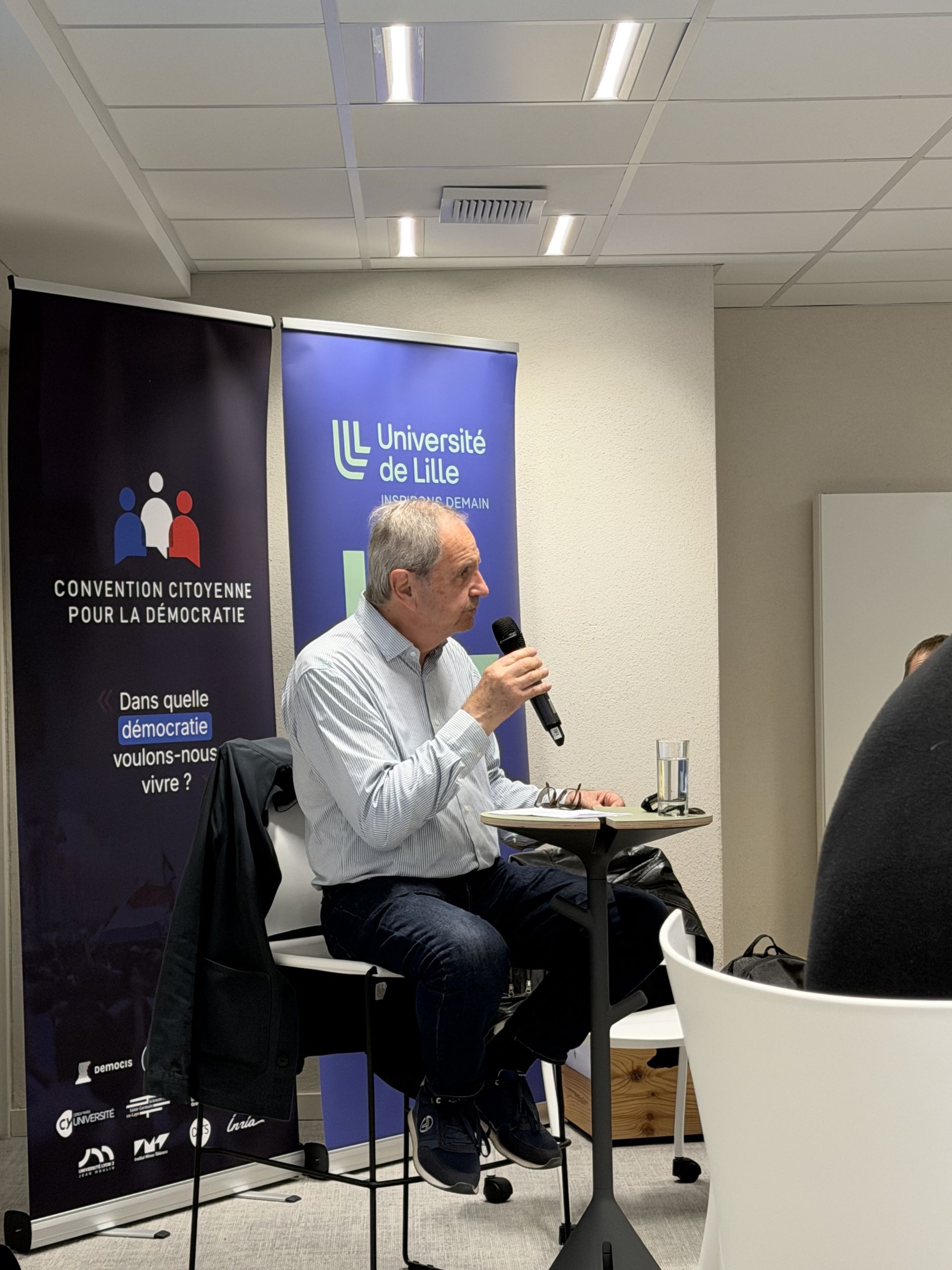
Constitutional law scholar Anne Levade, for her part, calls for caution. Changing institutions does not necessarily mean rewriting the Constitution. The Constitution, she points out, is not democracy itself but the framework within which it unfolds. Its stability is also a safeguard: political actors need to know the rules of the game and be able to count on their continuity. A framework, however, must not become a straitjacket. The same Constitution can give rise to several practices and interpretations. Her warning can therefore be summed up in one idea: amending the constitutional text does not automatically transform political life. Any revision may have effects beyond those intended.
Four Weekends to Move from Lived Experience to Proposals
The next three sessions will take place in Lille on 10–11 October, 14–15 November and 12–13 December. The Convention’s recommendations are then due to be presented in early 2027, with the aim of contributing to public debate in the run-up to the presidential election.


