



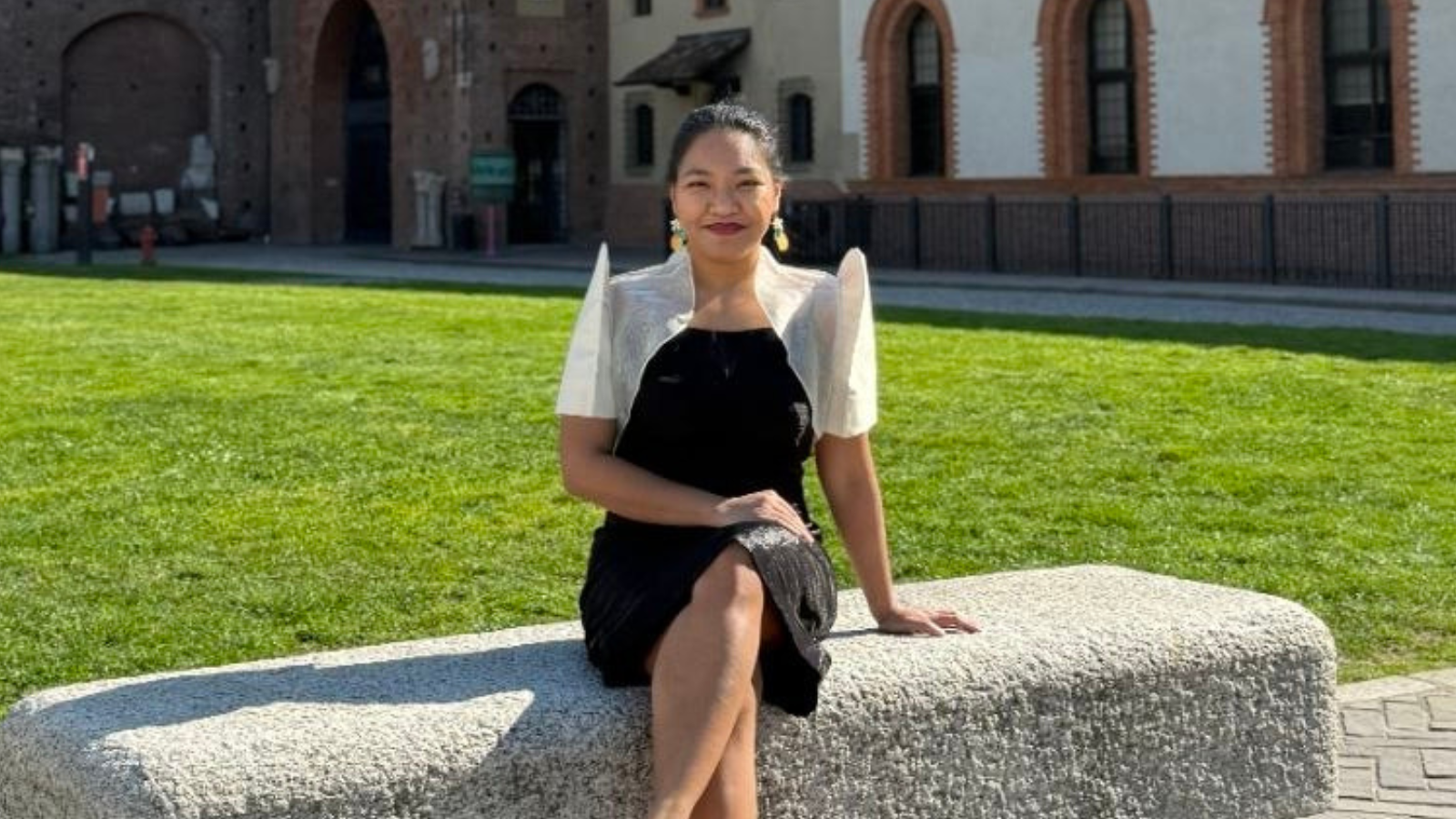
In high school, Julienne Alexis Joven dreamed of becoming a journalist. She wanted to tell stories, to bring reality into view, and to make voices heard. Over time, that desire never disappeared; it simply shifted. Rather than speaking for others, she chose to create conditions for them to speak for themselves. Originally from the Philippines, she is now a designer, entrepreneur, researcher, and committed advocate of citizen participation. A portrait of a new Missions Publiques fellow.
Julienne’s journey lies at the crossroads of the non-profit sector, public institutions, and academic research. It is a multifaceted path, but one clear thread runs through it: strengthening citizens’ participation, especially that of young people, in the governance and public policies that affect them.
Julienne grew up in the Philippines and became involved early in school life, where she was elected class representative. The context of her country played a decisive role in shaping her commitment. She describes a country where she feels both lucky and privileged to have been educated in civic issues, while remaining clear-eyed about the system’s limits.
Since the fall of the dictatorship in the 1980s, the Philippines has returned to a democratic framework, but one that remains fragile. The country is often described as a partially free democracy, marked by the rise of populism, the persistence of political dynasties, and growing distrust in institutions. And yet, the Philippines also has a vibrant democratic culture, with spaces for engagement at different levels, notably the barangays, local governance units where citizens can directly raise their concerns. Civil society is active, and many young people get involved early.
But this vitality coexists with deep fragilities. Public policies are unevenly implemented, civic space is shrinking, political dynasties continue to shape power, and democratic fatigue is growing, fuelled by unfulfilled political promises. Inherited in part from its political history, particularly the dictatorship of the 1970s, these tensions feed lasting distrust in institutions and hinder the political participation of younger generations.
It is in this context, and above all through her professional experiences, that Julienne became interested in citizen participation and in the way public policies are implemented.
Before turning to design and citizen participation, she began her career in communications within the Philippine Department of Social Welfare and Development. There, she observed closely the challenges of public policy implementation and helped promote social protection programmes, including Pantawid Pamilyang Pilipino, a conditional cash transfer programme for low-income families.
That experience marked a turning point. Julienne realised that many solutions already exist but remain invisible to those who might need them most. She came to understand that the challenge of public action lies not only in the idea and design of policies, but also in their implementation, their clarity, and their ability to inspire trust.
From that point on, her career took a turn toward design. Still in her twenties, she ventured into entrepreneurship by co-founding Fennel, a social design agency, with university friends. The project was first conceived as a communications agency, before quickly evolving into a design studio: developing tools, toolkits, campaigns, and materials for organisations with very different missions, ranging from the International Labour Organization to Greenpeace, as well as local governments and ministries.
Among Fennel’s most notable projects were the launch of one of the first national mental health campaigns in the Philippines in 2016. The organisation also helped design a political engagement programme aimed at bringing sectoral voices into national electoral priorities, working on a wide range of causes, from the environment to education and technology.
Gradually, it was in the field of youth that Julienne chose to anchor her long-term commitment. The Philippines has a very young population: around 30 percent are between 15 and 30 years old, which makes the question of younger generations’ participation in political life even more essential.
She then co-founded Hiraya, an NGO dedicated to youth civic and political participation. Hiraya’s aim — it was initially called Hiraya Kabataan, kabataan meaning “youth” in Filipino — is to encourage young Filipinos to become more involved in public and political life by offering them spaces to participate and to understand the role they can play. Through Hiraya, she helped lead training programmes for young elected members of the Sangguniang Kabataan, a distinctive institution in the Philippines made up of youth councils. Within this system, public office can be held from the age of 18, but such responsibilities require proper support. The Sangguniang Kabataan Academy Initiative (SKAI) was designed to help them better understand their responsibilities, the tools available to them, and the institutions with which they should work.
Julienne introduced human-centred design methods, organising workshops based on field research: young elected officials would go out to meet residents directly, identify the most urgent issues in their neighbourhoods, and then build their action plans based on this feedback. A concrete way of shifting power towards those it concerns.
She then left the Philippines to continue her studies in Milan, Italy, where she is now based. There, she earned a master’s degree in product and service system design at Politecnico di Milano, deepening her knowledge of systems thinking, service design, and participatory design, particularly in the fields of institutional and political innovation.
She devoted her thesis to the design of systems aimed at strengthening pathways for youth participation, especially within governance and public institutions. She focused on this issue following a concrete opportunity: the Philippine government’s wish to revise youth law RA 8044.
Initially framed as a problem of apathy, the issue was redefined by her research. Through fieldwork and interviews, she showed that low youth participation does not stem from a lack of interest, but from a design flaw in the system. Her work revealed that young people are not indifferent: they talk politics with their families, know their rights, react to injustice and corruption. But they encounter institutions that rarely produce tangible results: little feedback, little openness, political dynasties that close off possibilities, and sometimes the fear of being stigmatised or labelled an “enemy of the state” if they become involved. Under those conditions, why participate?
Her work therefore seeks to stitch the pieces of the system back together: to imagine mechanisms in which every citizen contribution leaves a trace, generates feedback, and leads to measurable impact. Her research now supports a clear ambition — to modernise participation tools, make better use of digital platforms, and establish genuine impact tracking, so that engagement does not disappear into a void.
From Milan, Julienne follows developments in her country from afar without ever losing touch with it. She continues to work with the Hiraya team, takes part in the campaign against political dynasties, and pursues her work as a product designer in the private sector. Her journey, at once impressive and varied, speaks for itself. She has not abandoned her original desire to tell the world’s stories. Over time, she understood that her role was not to be the voice of others, but to create conditions for everyone to speak and be heard.


